Busan to Gyeongju Ancient Capital
- Duration
- ≈ 11.5 hours08:10 first pickup, ≈ 19:50 last drop
- Stops
- 9
- Pickup
At a glance
A quick read on scenery, walking comfort, and overall fit.
- Photo Potential
- Scenery
- Walking
- Rain Suitability
- Family Suitability
- Pace
See the route atmosphere
Before the details, this is how the day feels.
Your Day, Stop by Stop
Each stop builds naturally into the next. Expand any for full detail.
How this day flows
Pickup & Drop-off
Pickup included. Tap any location for details.
Pickup
3 pickup points
08:10 – 09:10
Busan Station Exit 4 (Subway Line 1 — NOT the KTX railway station)
Seomyeon Station Exit 4 (Subway Lines 1 & 2)
Haeundae Station Exit 5 (Subway Line 2)
Drop-off
Approximate
~19:50
approx.
Return available to
What's included
Round-trip mini-van transport from Busan, certified English/Chinese-speaking guide, fuel/…
Included
- Round-trip mini-van transport from Busan, certified English/Chinese-speaking guide, fuel/tolls/parking.
- All other site admissions are free: Bulguksa (free since May 2023), Gyeongju National Museum permanent exhibitions (free since 2008), Gyochon Hanok Village and the Choi Family House, Woljeonggyo Bridge, the Daereungwon park grounds, Hwangnidan-gil.
Not included
- Not included: lunch (≈₩15,000–₩25,000), Ahopsan Bamboo Forest admission (adult ₩8,000 / under 18 ₩5,000, paid on site), Cheonmachong interior (adult ₩3,000, optional), Donggung & Wolji admission if you choose it instead of the museum (adult ₩3,000), tips.
Why this tour suits you
Who this cadence suits and how the day is sequenced.
- Travelers who want Gyeongju's classic stops without rushing
- First-time visitors to Korea
- Adult families and couples
- Travelers who like an afternoon that is walked, not driven — Choi Family House to Woljeonggyo, Daereungwon to Hwangnidan-gil
- Travelers who like a hands-on moment — rice-cake making at Gyochon Garam
- Travelers who need an early evening return — Busan drop-offs run ≈19:00–19:50
- Travelers needing minimal walking (≈5–5.5 km across the day)
- Stroller-heavy groups (Bulguksa has stone steps — though Daereungwon is flat)
- Travelers needing a tight same-day flight buffer
Why this route is built this way
The same order as the tour's OTA listings
This page follows the order the operator publishes on Klook and GetYourGuide: Ahopsan → lunch → Bulguksa → Gyochon (rice-cake making) → Daereungwon & Hwangnidan-gil → Gyeongju National Museum or Donggung & Wolji → Woljeonggyo. What you book there is what you get here.
Museum or royal pond — your choice
Gyeongju National Museum is the default (free). Guests who would rather be outdoors can choose Donggung Palace & Wolji Pond instead, five minutes away, for ₩3,000 paid on site. The museum's Wolji Hall displays the artifacts dredged from that same pond, so either choice tells the same story.
See it at the tomb, then see it at the museum
You stand beside the Cheonmachong tomb at Daereungwon, and the actual Cheonmachong Gold Crown (National Treasure No. 188) from that tomb is on display at the very next stop, Gyeongju National Museum. The order itself does the explaining.
Every pickup point is a subway station exit
Busan Station Exit 4 (Line 1), Seomyeon Station Exit 4 (Lines 1 & 2), Haeundae Station Exit 5 (Line 2). At Busan Station in particular, we meet at Exit 4 of the subway station in front of the building, not inside the KTX railway terminal — the train station plaza mixes buses and taxis and makes a vehicle hard to find, while a subway exit number is something anyone finds in one go. Drop-off is at the same three points.
Mini-van size, between a coach and a private car
Coach tours from Busan carry 35–45 passengers cheaply; private tours carry 1–4 at a much higher rate. This small-group mini-van sits between the two — fewer people means faster reassembly at each stop, and that time turns straight back into time on site.
Practical details
Pickup, walking, weather, packing, and inclusions.
Live weather · East Jeju region
How this route feels through the year.
Spring (mid-Mar to mid-Apr, cherry blossom season)
Daereungwon's stone-wall lane is one of Gyeongju's finest cherry tunnels (with a festival in early April every year), and Gyochon and the banks around Woljeonggyo blossom in early April too.
Summer (Jun–Aug)
The bamboo forest stays cool and the museum is air-conditioned. Both afternoon walking blocks have shade and cafes to rest in, and Woljeonggyo at 17:00 is still in full daylight.
Autumn (late Sep to late Oct)
Gyochon's ginkgos peak in late October, and the grass mounds of Daereungwon make the easiest walking of the day. The museum stays open until 20:00 on Saturdays from March to October.
Winter (Nov–Feb)
The quietest season of the year. Sunset comes at about 17:15–17:30, so the last stop, Woljeonggyo Bridge, catches the late light — and Donggung & Wolji remains an option instead of the museum all year.
- Pickup runs in sequence at three subway stations in central Busan: Busan Station Exit 4 (Line 1) at 08:10
- Seomyeon Station Exit 4 (Lines 1 & 2) at 08:30
- Haeundae Station Exit 5 (Line 2) at 09:10.
- Busan Station means Exit 4 of the Line 1 subway station, not the KTX railway terminal. If you wait in the train station concourse or on the plaza you will not see the vehicle.
- Drop-off is in reverse order
- at the same exits you boarded at: Haeundae Station ≈19:00
- Seomyeon Station ≈19:30
- Busan Station ≈19:50. The end time can vary with traffic.
- Provide a WhatsApp or KakaoTalk number at booking; the guide will message vehicle details the day before.
- Moderate.
- Total walking distance across the day is ≈5 km, spread over short blocks — Gyochon, Daereungwon ↔ Hwangnidan-gil, and Woljeonggyo Bridge at the end of the day.
- Bulguksa has stone steps between terraces. Gyochon, Daereungwon, Hwangnidan-gil and Woljeonggyo are all flat, and Daereungwon's grass paths are comfortable for strollers and older guests.
- Climbing the tomb mounds is prohibited (fines apply). Comfortable closed-toe shoes essential — Bulguksa stone is uneven.
- Free cancellation up to 24 hours before pickup.
- Same-day cancellations and no-shows are non-refundable.
- If the tour is cancelled because of force majeure, severe weather, or road closure, full refund applies.
- Gyeongju National Museum is the default stop and is free (hours 10:00–18:00, last admission 17:30; closed only Jan 1, Seollal and Chuseok).
- Guests who prefer to be outdoors can visit Donggung Palace & Wolji Pond instead — five minutes away, adult ₩3,000 paid on site. Tell your guide on the day.
- Either way the day ends on Woljeonggyo Bridge at about 17:00 before the drive back to Busan.
Booking & support
At checkout, add a phone, WhatsApp, and LINE you actually use. You’ll get a confirmation email next, and the day before the tour your guide contacts you on WhatsApp, LINE, or phone.
Immediately
Instant Confirmation
Booking confirmation with itinerary summary
12 hours before
12-Hour Reminder
Weather update and any route adjustments
Evening before
Final Pickup Info
Exact pickup time and driver contact
Booked with AtoC Korea, run by a licensed local partner operator.
- Licensed local tour provider
- Route specialists
- Comfortable group size
Questions
The few questions that usually decide it.
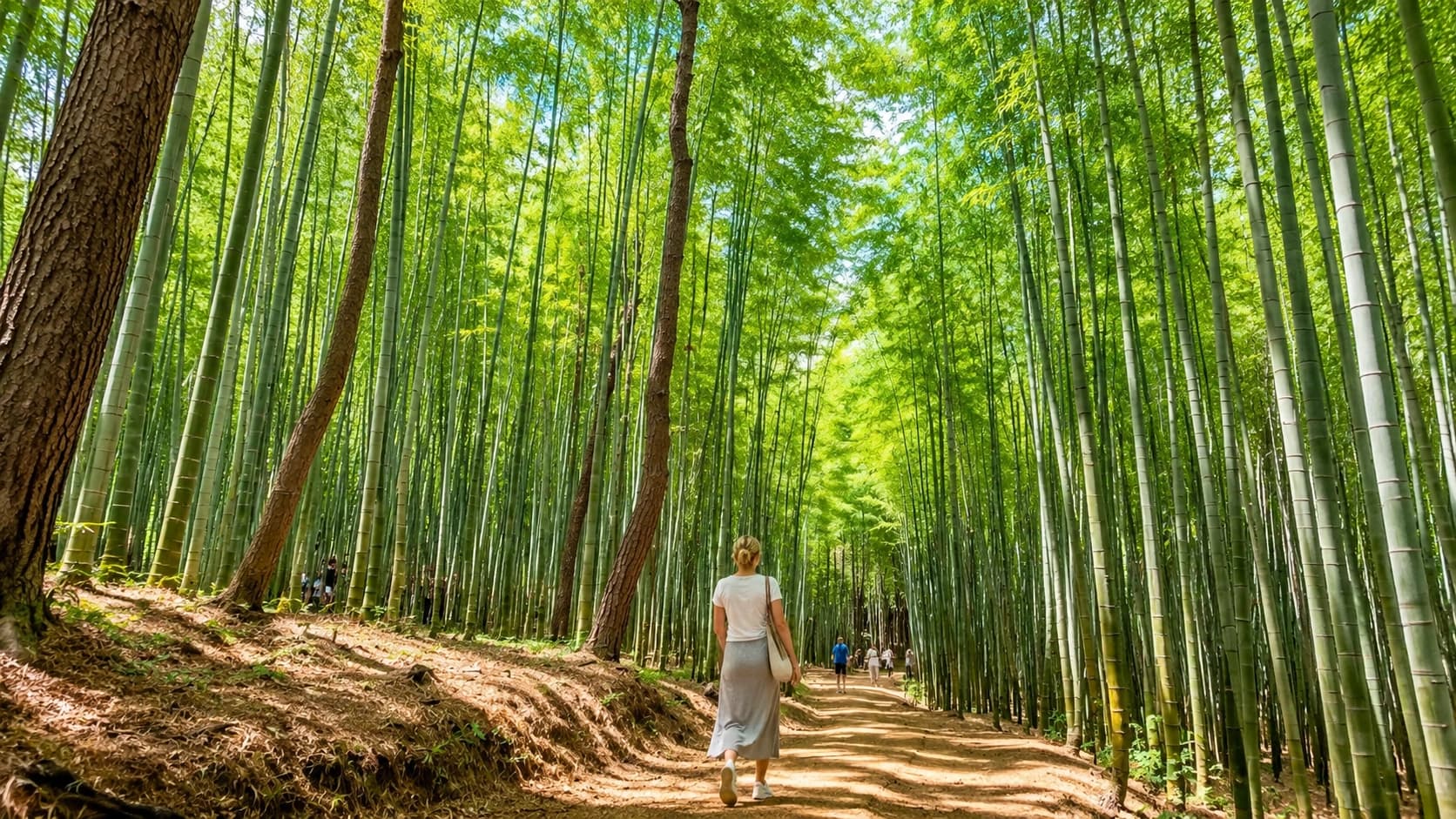
You leave the three Busan subway stations between 08:10 and 09:10, walk Ahopsan Bamboo Forest (60 min), then have lunch as the van reaches Gyeongju (60 min) and walk UNESCO Bulguksa (75 min). The afternoon is short walked blocks: rice-cake making in Gyochon Hanok Village and the Choi Family House (45 min), the Daereungwon tombs and Hwangnidan-gil (60 min), then Gyeongju National Museum — or Donggung & Wolji, by choice, ₩3,000 on site (40 min). The day ends on Woljeonggyo Bridge at about 17:00. Drop-off in Busan is Haeundae Station ≈19:00, Seomyeon Station ≈19:30 and Busan Station ≈19:50 — ≈11.5 hours in total. This is the same order as the tour's Klook and GetYourGuide listings.
Woljeonggyo is the last stop, at about 17:00. In summer that is still daylight; in the shorter days of late autumn and winter the sun is low or setting by then, and the bridge lights may be coming on as you leave. The tour does not wait for full darkness — the van leaves for Busan after about 40 minutes at the bridge.
Seokguram is on the same UNESCO inscription as Bulguksa but sits 8 km up the mountain by a steep narrow road, with parking constraints and a 10-minute walk from the lot. The combination makes it impractical to add to a day that also includes the museum, Gyochon, and the bridge. Most one-day Gyeongju tours include Bulguksa or Seokguram, not both.
Most sites are free. Free: Bulguksa (since May 2023), the Gyeongju National Museum permanent exhibition (since 2008), Gyochon Hanok Village and the Choi Family House, Woljeonggyo Bridge, the Daereungwon park grounds, and Hwangnidan-gil. The rice-cake experience at Gyochon Garam is included. Paid on site: Ahopsan Bamboo Forest adult ₩8,000 / under 18 ₩5,000 (required) · the Cheonmachong tomb interior ₩3,000 inside Daereungwon (optional) · Donggung & Wolji ₩3,000, only if you choose it instead of the museum · lunch ₩15,000–₩25,000.
Yes. Major exhibits carry bilingual Korean/English panels, and a recent renovation added digital labels. The permanent exhibitions are free, hours are 10:00–18:00 (last admission 17:30), and regular closures are Jan 1, Seollal and Chuseok only — so it is open as normal on Mondays. This tour arrives in the mid-afternoon and spends about 40 minutes on the highlights: the gold crown, the Emille Bell and the Wolji Hall. If you prefer, you can visit Donggung & Wolji instead (₩3,000 on site).
Yes throughout the temple grounds, including the two pagodas and lower-terrace stone bridges. Avoid flash and tripods inside the worship halls where services may be in progress. Cherry blossoms peak in mid-April; autumn foliage in late October — the most-photographed times.
Yes. Gyeongju ssambap is naturally vegetable-heavy; ordering it without meat banchan is straightforward. The guide can also route to a temple-cuisine (사찰음식) restaurant for fully vegetarian meals on request — please advise at booking.
Light rain: the tour runs as planned. Heavy rain: Bulguksa's stone steps get slippery and Ahopsan's earth paths get muddy, so the guide trims outdoor dwell and shifts the balance indoors — more time in Gyeongju National Museum (indoors and climate-controlled) rather than at open-air Donggung & Wolji, and at Daereungwon less time among the mounds in exchange for more time in Hwangnidan-gil's indoor cafes and shops. Typhoon-grade weather: rescheduling or a full refund.
Yes. The day covers Gyeongju's headline sites at an unhurried pace, which suits a first visit well — Bulguksa, the royal tombs, the museum and Woljeonggyo — and adds a hands-on rice-cake experience in Gyochon, so you come away having done something, not just seen a checklist of monuments. That said, if you want an early evening return, this is not the tour for you: the day runs ≈11.5 hours and Busan drop-offs are 19:00–19:50. In that case a shorter Busan-area tour is the better choice.
≈5 km across the day, in short blocks. Bulguksa is the most active part (uneven stone, gentle uphill); Gyochon and Woljeonggyo are flat; Daereungwon's grass paths are flat and step-free; the museum is flat indoor walking. Comfortable closed-toe shoes essential.
Yes for school-age children (≈8+) who can manage a full-day rhythm. The museum's gold crown and the giant bell are typically the kid-favorite stops; the bamboo forest is sensory-friendly. Younger children may flag during the museum visit.
Recommended for active seniors comfortable with ≈5–5.5 km of walking and uneven stone at Bulguksa. The afternoon is easier than the distance suggests — Daereungwon is flat, step-free lawn, and Hwangnidan-gil has plenty of cafes to sit down in. Do be aware the day is long: ≈11.5 hours, with drop-off back in Busan around 19:50.
Best fit is around age 8 and up. The day covers ≈5–5.5 km of walking and runs ≈11.5 hours (08:10 first pickup, ≈19:50 last drop), so a child needs to be comfortable with that rhythm. The two afternoon blocks are actually the kid-friendliest part of the day — Daereungwon is flat, step-free lawn paths with room to move, and Hwangnidan-gil has cafes and Hwangnam bread. The museum's quiet galleries and the early start are the harder parts for young children.
It is a street of cafes, studios and gift shops converted out of hanok houses, directly across Daereungwon's west wall. The name means 'Hwangnam-dong's Gyeongnidan-gil', and since around 2017 it has been the youngest street in Gyeongju. You get roughly 20–30 minutes of free time — enough for a coffee, a box of Hwangnam bread (the red-bean pastry that started in this neighbourhood in 1939), and a restroom stop. Anything you buy is at your own expense.
Yes. Gyeongju National Museum is the default and is free. If you would rather be outdoors, you can visit Donggung Palace & Wolji Pond instead — five minutes away, adult ₩3,000 paid on site. Tell your guide on the day. The museum's Wolji Hall displays the 33,000-plus artifacts dredged from that same pond, so either choice tells the same story.
All three are subway station exits — Busan Station Exit 4 (Subway Line 1), Seomyeon Station Exit 4 (Lines 1 & 2), Haeundae Station Exit 5 (Line 2). At Busan Station in particular we meet at Exit 4 of the subway station in front of the building, not inside the KTX railway terminal. If you wait in the train station concourse or on the plaza you will not see the vehicle, so please navigate by the subway exit number. Drop-off is at the same three points.
Questions before booking?
Reviews from Klook & GetYourGuide
Shown exactly as travellers wrote them on those platforms — not translated or edited.
- GetYourGuide2025-09-09
Louise · South Korea
Great time, we're having a great time. Thanks a lot for this day ☺️
- GetYourGuide2025-10-08
Clément · France
Jay was a super friendly, flexible, and passionate guide, always ready to share his knowledge.
- GetYourGuide2025-10-03
Oksana · United Kingdom
Kang was the best driver guide, always smiling and caring, speaks good English
- GetYourGuide2025-10-15
Marcia · United States
It was a well planned day. and our guide Yaho was great.
- GetYourGuide2025-09-20
Fabienne · Switzerland
kang was a great guide and told us some interesting things about history. thank you!
- GetYourGuide2025-10-04
adrian · Poland
Trip was great. A lot of interesing Silesia. And our guide Kang, did really good job!!! Thank You :)
- GetYourGuide2025-10-07
Amy · United States
It was a great trip! Kang was very knowledgeable and made the tour an amazing experience!
- GetYourGuide2025-09-30
Elisa · Italy
A really knowledgeable and engaging guide, with an interesting and fun experience. Highly recommended!
- GetYourGuide2025-11-13
Isabell · Australia
DK was an amazing tour guide and I highly recommend this tour!
- GetYourGuide2025-10-12
L. · United States
Our guide Kang is great! We had a great time with him today. gyeongju is definitely worth visiting.
Also listed on
The same tour is listed on these platforms — open them to see its page and reviews there.
You might also like
Different pacing, different emphasis. Each is its own day.

Busan Top Attractions Day Tour
$22

Busan Small-Group: Sea Temple, Sky Capsule & Culture Villages
$63

Jeju East UNESCO Day Tour
$44

Jeju Round-Island Grand Highlights — Small Group, Hotel Pickup
$112

Jeju Southern (Seogwipo) Signature Day Tour
$44

Busan Private Car Charter
$265